Articles
October 13, 2026
Listen, Lynda. Honey.
How Time, Distance and Listening to Myself Brought Me Back to the Core of My Story
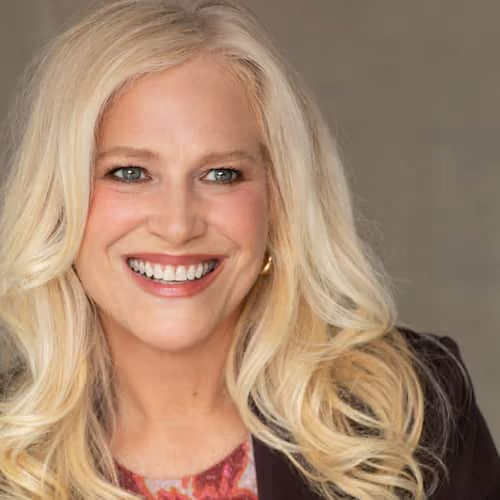
Lynda Halligan
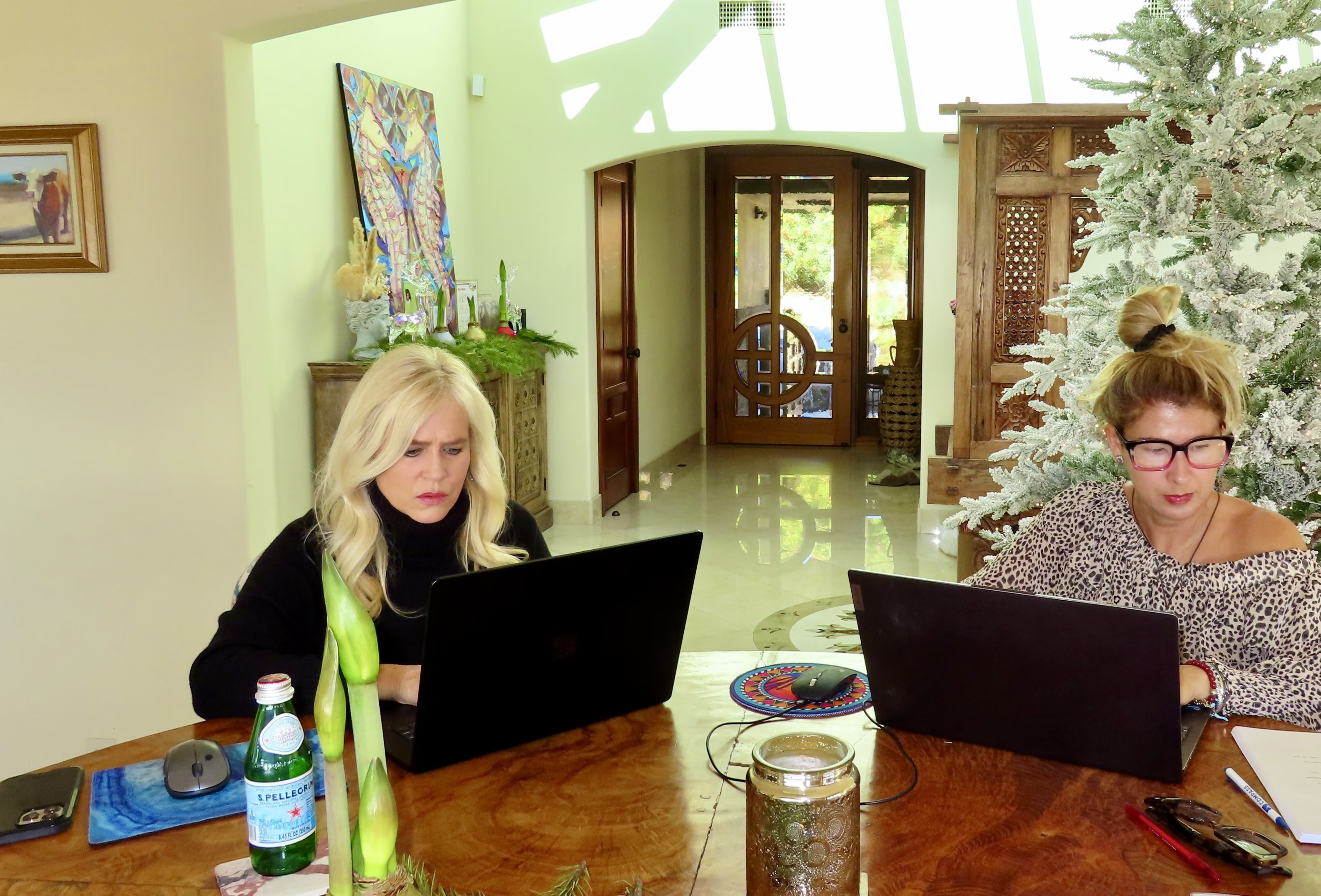
A close friend recently reached out to get a “writing day” on the calendar. We're not writing partners, and we write completely different things, but every so often, we sit at her dining room table for hours, each working on our own screenplay. It's a fun way to hold each other accountable.
There was just one problem. This time, I had no idea what I was going to work on.
I'd put screenwriting aside while rebuilding my business, Halligan Media. Should I start something new? Revisit an old project?
“Screenwriting is rewriting,” as they say.
That line even appeared in an episode of The Shards I watched recently. I LLOL'd. Literally laughed out loud.
Yeah, yeah. I know. Screenwriting IS rewriting.
I went back to the drawing board, so to speak, on a screenplay I first conceived in 2019, during my first semester of graduate school. After several drafts, a few titles, changes in direction and rounds of feedback, I finished my last version in 2022 and needed to step away.
I “put it in a drawer” and apparently left it there for four years. That's an entire college career.
My most personal screenplay to date started as a feature film called The Broken Yolk. Then it became The Inner Core, a half-hour comedy pilot. Next came Live, Local, Latebreaking, a one-hour dramedy. And now it's Late Breaking, a half-hour dramedy. This time, the title is staying. That is, until it's out of my hands.
Four titles. Four incarnations. More drafts than I care to count. And somewhere along the way, I'd lost sight of why I wanted to tell the story in the first place. And with that, I'd lost what readers had initially connected with.
Its heart.
Most screenwriters I know — or have heard talking on podcasts — despise getting notes.
I'm actually one of those weirdos who welcomes them.
Feedback from an entertainment professional, someone in my screenwriting group or a friend who likes the same shows I do can help me flesh out a character, strengthen a storyline or recognize something that's perfectly clear in my head but isn't translating onto the page. More often than not, thoughtful feedback makes my work better.
But here's what I've learned: You can't please everyone. And you shouldn't try.
I believe in hearing every note and considering every note.That doesn't mean acting on every note. If I hear the same criticism from multiple people, of course I pay attention. I'm not a fool. If what I'm trying to communicate isn't coming across to those people, chances are others won't understand it either. It's time to take another look and figure out why it's not working.
And there's a difference between someone identifying a problem and prescribing a solution. The problem may be legitimate. The suggested solution may not be right for my story. It may not be right for me.
One of the best suggestions I received came from my graduate school advisor, who thought my feature might work better as a television series. He wanted to follow the main character and her journey week after week. He also believed well-known actresses in their 40s would want to play the role.
I heard his advice but pretty quickly dismissed it. To me, this was a story with a beginning and an end. It was better suited for a feature. Or so I thought.
Other notes, big notes, sent me in different directions. While well-intentioned, following those suggestions took me farther away from the story I wanted to tell. I was the one deciding which notes to follow, so I couldn't blame anyone else for where the screenplay ended up. Just like a strong lead character, I had agency!
I kept working. Revising. Rewriting. Changing the concept, the format, the characters and the direction. All that work was worthwhile, but eventually I reached a point where I wasn't sure where to go next. So, I went to that virtual drawer, dropped the screenplay in and wondered whether I'd ever take it out.
Flash forward four years, and it was time to dust it off, along with a lot of those notes.
"This script's greatest strength is its big heart." —The Black List
"The writer has a lively and witty voice, giving the script a very upbeat and comedic tone." —WeScreenplay
"It's a uniquely entertaining family dramedy that definitely pulls at the heartstrings…" —ScreenCraft
Readers praised the characters, dialogue, concept and emotional connection.
But the more I worked on the screenplay, the more I changed it, the worse some of my scores became.
I was planning to include some of the less positive feedback in this blog. But as I searched through those evaluations, I realized something. It wasn't what the readers of the later drafts were saying.
It was what they weren't saying.
The words heart, heartstrings, emotion, warmth and tenderness had disappeared from the feedback.
All those words describing how the script made people feel in the beginning had gone bye-bye.
And I was beginning to understand why.
In trying to make the story better and get it into the hands of "the right people," I'd gradually lost my own connection to it. The very thing that made it personal to me.
This was MY story. My unique story that no one else could tell.
I didn't write it for them. I wrote it for myself.
Of course, it wasn't a documentary. It wasn't all true. But the characters, situations and emotions were rooted in real-life experiences that mattered deeply to me.
And even though my story was specific, much of it was universal. People didn't have to live my exact experiences to recognize the feelings, relationships, hopes, disappointments and conflicts.
That's what made it relatable.
Fortunately, with time and distance comes clarity.
I could look at the project with fresh eyes, remember why I wanted to tell the story in the first place and recognize which changes had made it stronger and which had taken it away from what mattered most.
But those years gave me something else, too: perspective on my own life.
Much of the screenplay was inspired by my experience moving in with my then-fiancé and becoming a mom overnight. My stepson had just entered his freshman year in high school when I began writing it. Now he's 22.
The three of us have been through a lot together. I feel like we've finally reached the light at the end of a very long tunnel.
That doesn't mean there won't be more tunnels. There will be. Hopefully not as many as Norway, but there will be.
The difference is, we're better equipped to navigate them now.
And being on the other side of that real-life drama makes it easier to revisit those experiences, recognize the humor alongside the heartache and tell the story with a perspective I couldn't have had years ago.
Something else has changed, too.
There are now television shows with themes, tones and formats much closer to what I've envisioned for this script. And they're attracting audiences, receiving nominations and awards, and demonstrating that there may be a place for this kind of project.
Maybe this is the right time for this show. Maybe it isn't. But the possibilities feel different than they did years ago.
If you take anything from this blog, my advice would be this: Listen.
Listen to the people trying to help.
Whether you're a screenwriter, an executive, an entrepreneur, a student or someone trying to communicate an idea, you can learn a tremendous amount from other people's perspectives.
But listening doesn't mean agreeing. And it certainly doesn't mean acting on every suggestion.
You have to know what you're trying to accomplish and recognize when feedback is helping you get there or pulling you away from your goal.
And by all means, don't forget to listen to yourself.
I recently finished the latest draft of Late Breaking. Is it the final draft? Of course not. Is it even good? Hope so.
I've submitted it for more professional feedback. I'll read every note, consider every suggestion and make changes when I believe they'll improve the screenplay.
But this time, I know what I'm trying to protect.
The heart. The emotion. The authenticity. The things that made me want to tell this story in the first place.
Would I love to see Late Breaking on television someday? Absolutely!
But even if that never happens, the work I've put into this project and everything I've learned along the way have made the journey worthwhile.
As you create and as you go through life, I encourage you to be open to learning, growing and changing.
But don't lose yourself in the process.
Listen, Lynda. Listen.
https://www.youtube.com/watch?v=aFYsJYPye94
Remember this video? Twelve years ago, Linda Beltran posted about how her three-year-old son argues and debates about everything. So far, it's gotten more than 41 million views and people still quote it to me.
.avif)